The Board-of-Tourism invents the mythical New England moose. Also, a smart seagull in Bar Harbor and the Lake Ontario skunk. Graniteville, Vermont.
“So that’s New England out of the way”, said Mrs Henry, writing in her official travel diary, or rather, I thought, not writing, but making a movement I associated with the notching of a tick.
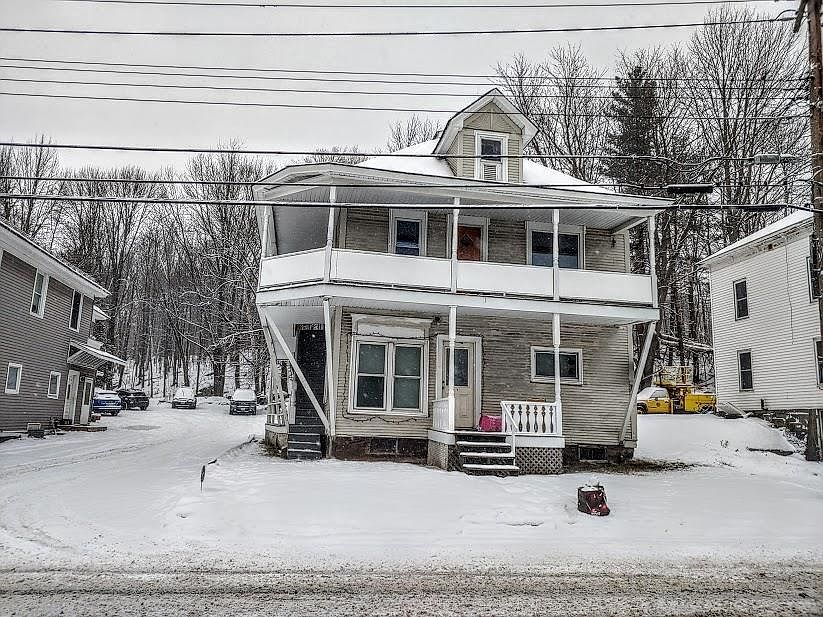
Boston, Cape Cod (where we profitably visited a thrift shop, although a bit too macabre for my taste: just racks and racks of dead husbands’ shirts), Plymouth, a squillion cute little towns, Bar Harbor, the White Mountains and Vermont, where in Graniteville, Vermont,
Mrs Henry and I experienced our first night of freezing conditions. It was a Mr Henry clad in tracksuit pants, hoodie and white tennis socks that presented himself to Morpheus’s arms.
After Graniteville, a dash across mountainous roads that drove Mrs Henry into a high funk (“Slow down, slow down!”, when I was doing ten kilometres an hour in deference to said funk) and a visit to yet another thrift shop to settle Mrs Henry’s nerves.
The New England mountains in autumn, the streams that ripple alongside the winding roads, lots of very beautiful, very trite stuff.
So, what can we talk about in New England, other than its rippling streams alongside its roads, its mountains hills, trees?
About moose.
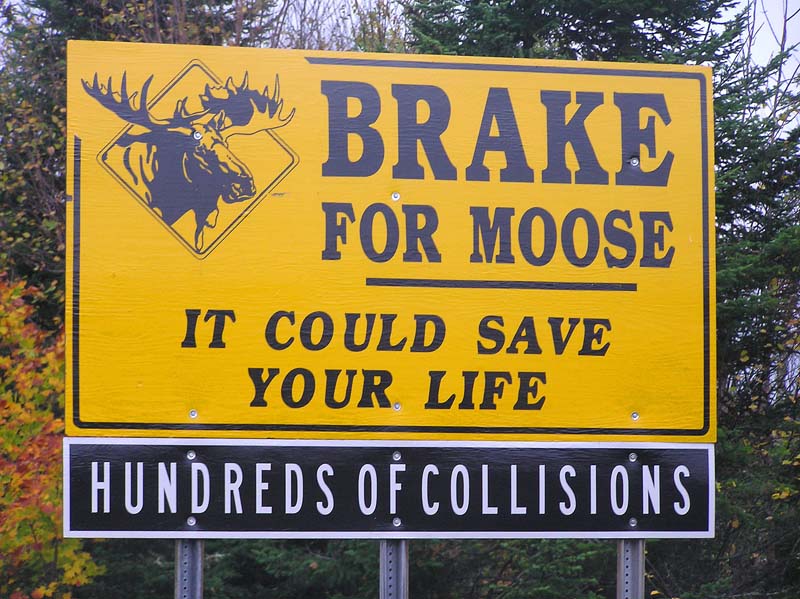
Haven’t seen any. Not even one without antlers. What we have seen are road signs warning against moose, not just the yellow moose head triangle and the words “crossing next [x number of] miles”. There is also a massive rectangular sign that explores the issue further. “Brake for moose – it could save your life – hundreds of collisions”, it warns. No moose anywhere to be seen, though.
Could it be just something that the New England Tourism Board has dreamt up? Fully aware that, apart from a couple of geriatric moose living well away from human settlement and activity and not getting out much these days anyway, there are no moose left in New England, the Board decided to simply put up warning signs to make out that the New England moose population is raging and basically out of control. I mean, in Gorham (pronounced, Gore Ham) at the foot of the White Mountains in New Hampshire there is a moose sign outside the local Walmart!
Now, what confirms Mrs Henry and myself in our belief that the New England Tourism Board is trying to pull a swiftie here is that there is a moose warning sign as you approach Gore Ham Walmart from the east, but that there is no such sign when you approach Walmart from the west.
“Makes you think, don’t it?”, said Mrs Henry tapping the right-hand side of her nose with her right-hand index finger knowingly. “What’s the bet the moose have all moved to Florida?”
No moose, not even a dead one, whereas we have seen a lot of dead, other wildlife.
In Bar Harbor, Maine, a couple of days ago Mrs Henry and I did do some live wildlife watching. It concerned a sea gull, which in Australia limit their flying to an absolute minimum, and when they fly they waddle-fly, morbidly obese as they are from all the chips they scavenge.
We were sitting in our camp chairs outside the Egg, watching a sunset, when we noticed this sea gull flying around with something big in its beak. A hamburger? No, it was a large shell.
After a few fly-bys, the gull flapped its wings to achieve reverse thrust, so that it was hanging still in the air, and opened its beak to release this shell, which burst open when it hit rocks below, a little jet of water squirting brilliantly in a ray of the dying sun. The gull then tracked round and landed where it had dropped the shell and ate its contents. It repeated the routine and when it had finished eating, it seemed to look at us and walk away towards the water with a little swagger.
New England is past us now. Mrs Henry and I are encamped on the shores of Lake Ontario, precedent to reaching Niagara Falls.
As we downed our end-of-the day Budweiser at dusk, a feline creature with shining, green eyes made its way towards us from the shoreline.
“It’s a skunk!”, yelled Mrs Henry alarmed, because skunks don’t just stink, they spray in defence, and it’s the stench of that spray that should be feared. It apparently lasts a lifetime.
So, we threw rocks until away the skunk slunk.
