Sightseeing buses are much maligned by tourists who don’t consider themselves tourists, but to get to know the lay of the land in American cities, they’re a must! New York City.
What a great place New York is! Where, say, in London and Paris the tourist gets browbeaten by beauty and history, there’s none of that in New York!
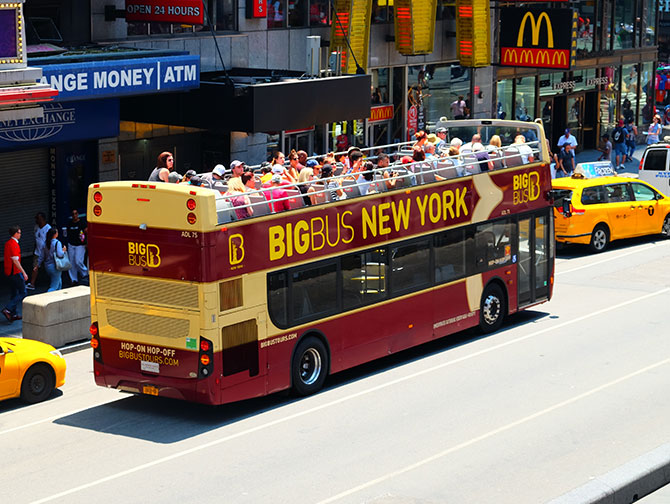
Open-upper-deck double-decker bus sightseeing may be tacky, but it does mean far less walking. We did the Downtown Loop, the Uptown Loop, the Brooklyn Loop, the Harlem Loop, the Bronx Loop and the Night-time Loop, which replicates the Downtown Loop, the Uptown Loop, the Brooklyn Loop, the Harlem Loop and the Bronx Loop, but after sundown. Personally, I was worn out to such an extent by the time we did our last loop, the Night-time Loop, that I managed to nod off repeatedly, which is no mean feat given the combination of the potholed roads in New York and my position on the upper deck. These buses sway like camels.
Mrs Henry and I have to pay tribute here to the many tour guides. There’s the chap who kept lamenting the fact that the sound system didn’t work. Didn’t tip him. There was Ho-Zay, our Brooklyn Loop guide, who almost threw a passenger off the upper deck for standing up while the bus was in motion, along the same principle as the American general who destroyed the Vietnamese village to save it. A gentle, informative giant, Ho-Zay, laughing consistently at his own jokes, particularly the one where he said he was going to point out to us his favorite Chinatown “res-a-rant”.
“Dere it is, ladies and gennelm’n, dere it is! Chinatown McDonald’s!”
Then there was the lady guide, who made a point of telling us that, after a “career in graphic design, you know, book covers and so on”, she decided that she wanted “to talk to people”, so what better choice was there than becoming a tour guide on a double-decker sightseeing bus?
But the crown goes to the tour guide from Kazakhstan who had learnt English by correspondence course, including pronunciation.
“Wat-che. Your a head. In your right hand. Lay-dies and gentlemen”, was his consistent warning, announced too slowly to make any difference, against low hanging tree branches
“And a now. Lay-dies and gentlemen. In your left hand. You will a see a Rock-a-veller Centre. G-h-ow many buildinks inna Rock-a-veller Centre? Dere are nineteen buildinks inna Rock-a-veller Centre.”
All in all, as a result of the Loops, Mrs Henry and I are now well-versed in the lay-out of New York and three of its five boroughs. Queens, of course, we traversed on the way from JFK Airport, and we suggest that the road through it should be flanked by six metre high screens. Staten Island we didn’t visit. The ferry to it is free, because, as one New Yorker told us, “There’s nothing there”.
The same could be said about Manhattan. Grand Central is beautiful, especially the Vanderbilt Hall, but the Chrysler building, apart from its famed spire and eagle gargoyles, is a very ordinary building. The Empire State Building is unremarkable and nothing more than a back-up highest building in case the new Freedom Tower gets taken out.
The Freedom Tower, not finished yet, is a vulgar glass monstrosity of the type that is quite de rigueur the world over these days. The Twin Towers, which in my pre-Institute days, I saw in their final stages of construction, had nothing going for them either, except height.
There really are two Manhattan skylines. Manhattan was built as a city of skyscrapers, except that the initial skyscrapers, from the beginning of the twentieth century were, by today’s standards, not all that high. The French writer Céline described New York as “une ville debout”, which I translate as “a stand-up city”, but Céline’s description pre-dates even the Chrysler and the Empire State. Céline’s hero Ferdinand Bardamu, who finds himself in New York in the early 1920s, is so overawed and overwhelmed by the height of the buildings that he flees into a public toilet underground, where he experiences the communal, doors-off-the-hinges ritual of male communal shitting in a fog of cigar smoke, a practice no longer extant today.
Viewed from Liberty Island, you can make out the old Manhattan skyline. It’s a browny colour and without the superimposition of the new skyline would be quite beautiful.
Sitting under the old Manhattan skyline are a great many landmark buildings. As Ho-Zay put it, “In Brooklyn, church towers are still higher than other buildings. In Manhattan it’s the other way around.” The Metropolitan Museum of Art, the New York Public Library are low-rise, ornate buildings. Architecturally, Manhattan was set on the same course as Washington, with cookie-cutter Neo-classicism. The Guggenheim building is a welcome low-rise addition, although it looks very Warnambool.
