A North Carolinian shopkeeper, gobsmacked that Austria is a peanut producer. Wilmington, North Carolina; Charleston, South Carolina; Savannah, Georgia. Salt peanuts, salt peanuts!!!!!!
Just as Joseph Banks collected thousands of botanical specimens during Captain’s Cook’s exploration of Australia, Mrs Henry’s collection of commemorative fridge magnets continues to grow as we travel the USA. New York, Philadelphia, Washington, Kitty Hawk and then a southern trio: Wilmington, North Carolina, Charleston, South Carolina and Savannah, Georgia.
Yes, the Mr Henry Institute has reached the southernmost point of its exploration of the New World.
Mrs Henry and I are currently encamped in the grounds of a former plantation, guided to our site by Joe, who is an African American in his fifties. I do not dare ask Joe how he feels about working on a former plantation. It is Joe who drives the tractor pulling the cart filled with white campers who want to have a look at the plantation house, which is not of Gone with the Wind proportions (in fact, it is smallish, which is typical for plantation houses in the USA). He pulls up just as the house comes into view. He stands up, turns around and gestures widely.
“This is the slaaay-ves ce-me-tary”, he explains, sits down, and the tractor and cart pull away. We circle the house without further comment from Joe, who points out the owners’ cemetery on the way back to the campground proper.
At eight o’clock in the evening Joe is still bustling about. Refilling gas bottles. Spraying a small section of lawn where someone claims to have seen a deadly spider. Escorting late arrivals to their site. At eight the following morning, on my way to the shower, I see Joe, who is already busy.
“Jeez Joe, you work long hours, don’t you?”
“Yes suh”, he replies, “From eight in the morning to eight at night, suh.” And he walks away.
Amazingly, golf clubs, campgrounds and facilities for assisted living all proudly advertise their former status as slave plantations on roadside billboards.
Would, you wonder, Americans – the liberators of Europe – countenance a Recreational Vehicle haven, or perhaps a luxury resort (with golf course) at the site of the Auschwitz concentration camp, with little ‘Arbeit Macht Frei’ fridge magnets for sale in the gift shop?
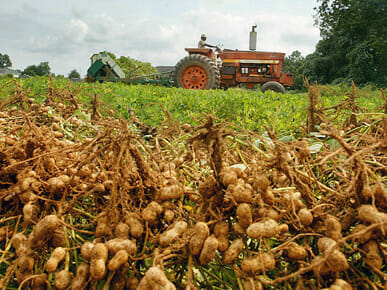
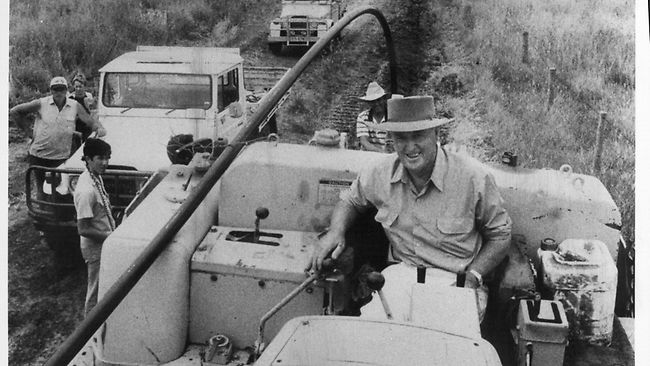
We entered the South via Virginia, where I commented expertly on the tobacco fields lining the road to Mrs Henry. These turned out to be soybean fields, but no matter. We bought peanuts at twice the supermarket price at a little roadside shop, Mrs Henry engaging the shop owner in conversation about Joh Bjelke Petersen (see photo below) and the peanut industry in Kingaroy, Queensland, more generally.
“Maaah, aaah had no aaah-dear Austria was a pee-nut proh-dooser, is that a fact, yes, indee-dee”, responded the shopkeeper.
Mrs Henry, after clearing up the topographical misunderstanding, enthused about the variety and range of peanuts produced in the greater Kingaroy area, the roasted chilli peanut earning a specific mention.
It had our Virginian shopkeeper shaking his head continuously in astonishment.
“Maaah, dere’s so much you can with a peeeee-nut”, he declared, “D’re’s no end to it, yes indee-dee.”
Consistent with Institute policy to avoid walking when a ride is available, Mrs Henry and I had boarded a Charleston tour bus, which meant sharing a confined space with yankee retirees from Florida. Towards the end of the tour, when all the ‘historic’ houses and all the heroic deeds of the Charleston-based Confederacy heroes had been told, the bus passed a large, concrete and glass office tower known as the Federal Building. It was empty, the guide told us, because it was riddled with asbestos. “Cay-n’t do nuttin’ with it.”
There were exaggerated cries of dismay and a gaggle of “Key-ant do nuttin’ widdit” echos, and then a single female Yankee Floridian voice was heard:
“Key-ant they just implode it or somethin’?”
When it comes to Wilmington, Charleston and Savannah, Mrs Henry and my money is on Charleston. It is the only town out of the three to have preserved its historic core without defacing it with modern buildings, not even ones that are designed to blend in, but don’t.
Wilmington has a few nice old houses and streets, and Savannahs has its famous squares, but both those cities have fallen victim to property developers. Savannah has even destroyed its foreshore by putting up some Soviet-style concrete bunkers and dotted throughout its historic district are some appalling modern constructions.
Housekeeping. Readers have contacted Mrs Henry and myself in their hundreds to inquire about the performance of the Egg and how Mrs Henry and myself cope in it. Well, neither the radio nor the TV works, and the left front tire has a wobble to it, which makes the Egg shake once a speed of about 70 kilometres an hour is reached.
Otherwise, the Egg has storage under the liberally sized bed and a small fridge, so that we can cook (outside the Egg) with fresh ingredients and, more importantly, keep the Budweiser cold. Mrs Henry and myself have added to the Egg’s internal design a nightsoil bucket, which, so far, has only been kicked over once. During the daytime, the nightsoil bucket contains our one-burner stove, mozzie repellent candle and stovetop espresso contraption. In upturned mode, it serves as an occasional table to spread out delicacies to go with the Budweiser.
There’s so much you can do with a nightsoil bucket.
