Policing Rome would be so, so much easier if the Swiss Guards got off their show pony butts and started helping out. At the Trevi Fountain, for example.
No less than three rings of security have been thrown around the Vatican by municipal police, who operate these rings in lackadaisical fashion. The first ring checks if the tourist is not bearing unconcealed or barely concealed weaponry. The second ring does much the same a little bit more ambitiously, as does the third, aided by airport baggage scanners dating back to the 1970s.
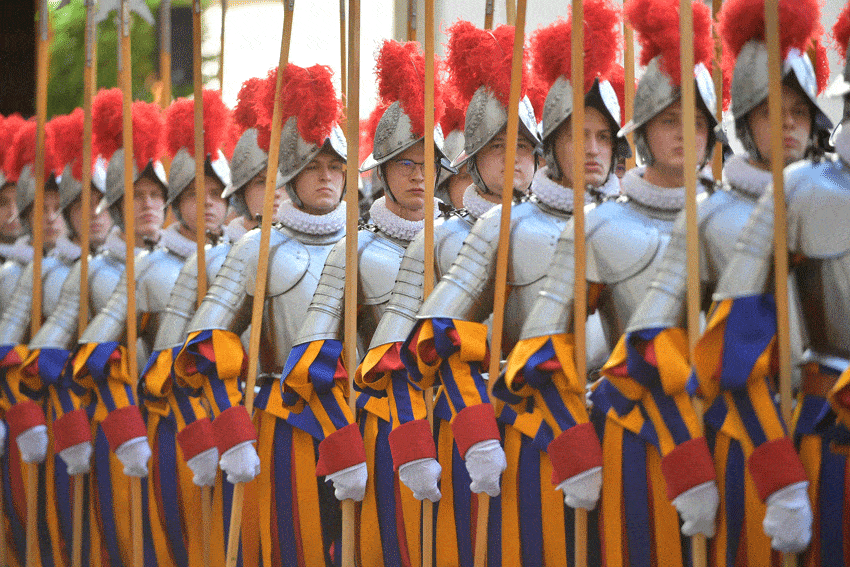
The Swiss Guard is not involved in any of this, which is a pity, because it would add to the pageantry of the Holy See. The Father, the Son and The Holy Spirit, sure-sure, but it’s all performance art, really. Now, as part of that performance art, you could have strapping young men implementing security in puffy, Renaissance dress uniform, blue, red, orange and yellow, wielding halberds, with the sun bouncing fiercely off their red-feathered morian helmets. Instead, it’s the cops, and to make matters worse they are not in uniform but have all been issued with green polo shirts. The locals, shaking their head, refer to the whole arrangement as the tre anelli di magliettas polo, the three rings of polo shirts, and you can understand why.
The three rings are as ineffective as they are time-consuming. In a blazing sun, with temperatures in the mid-30s, the wish to inspect St Peter’s Basilica and the Sistine Chapel loses some of its urgency. Thoughts turn to gelato and ice-cold Peroni.
Michelangelo, as Mrs Henry repeatedly points out, spent seventeen years on his back painting the ceiling of the Sistine Chapel, so what’s a few hours waiting in the midday heat? I reply that Michelangelo may have been on his back for seventeen years, but he was, one, out of the sun and, two, off his feet, whereas we are in it and on them.
Later in the day, we reach the Trevi Fountain and again the magliettas polo fiasco manifests itself.
Incidentally, I must confess that I had never before laid eyes on this monument and had not realised just how big it was. The Mr Henry Institute is accommodated in a light industrial area on the New South Wales Central Coast, wedged between a repairer of car radiators, Central Coast Radiators, and an enterprise which calls itself Central Coast Gardening Supplies, its statuary division being right up to, and the full length of the boundary with the Institute and clearly visible from the Institute’s staff cafeteria. Each morning when I go in there to have my morning cuppa and speak motivationally to all staff, as a leader must, the statuary inventory of assorted mythological figures, “water features” and renditions in poured concrete of contemporary fictional identities such as Spiderman and Robocop hits me, well, I was going to say, like a tonne of bricks, but that obviously is not the right metaphor. The reader gets my drift, though, and I must say I had a very much similar response when I set eyes upon the Trevi fountain.
However, I was talking about security at this Roman landmark being in the hands of people in polo shirts before I got side-tracked. Briefly, the custom is to throw a coin with the right hand over the left shoulder facing away from the fountain and to make a wish. Security is in place to prevent theft: it is not permissible for anyone to put their hand in the water. A whistle is immediately blown by a maglietta polo and … there, alas, the matter rests, because the crowds in the tiny piazza where the fountain are so dense that arrests cannot be made. Now, wouldn’t a skilfully wielded and smartly sharpened halberd applied to the wrists of would-be thieves by especially trained Swiss Guards confidently balancing on the edge of the fountain be a far more effective deterrent?
To ask the question is to answer it.
