Berlin’s horseshoe system of house-numbering can lead you astray.
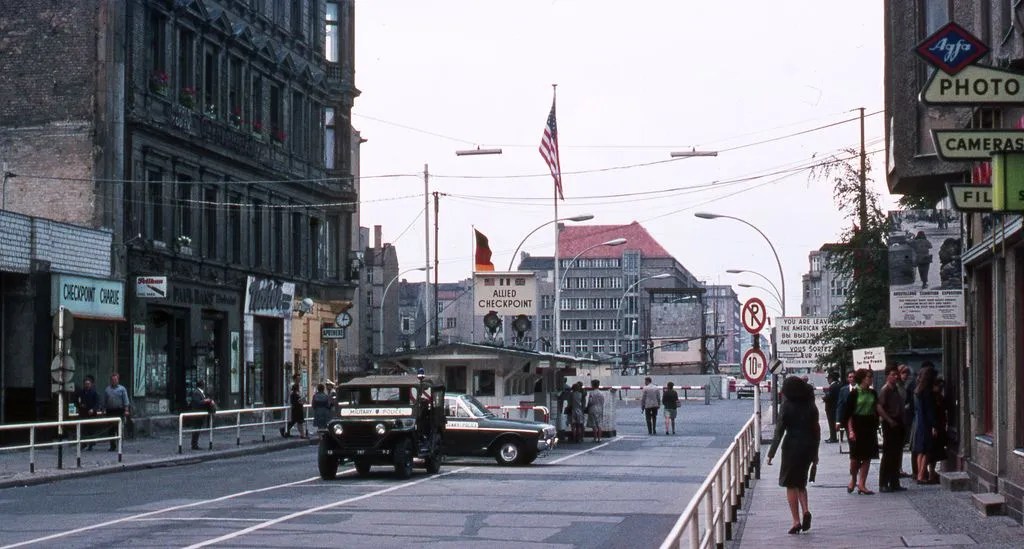
The short answer is that it’s at Friedrichstrasse 43-45.
A little promotional map says so. It’s put out by a city-tour bus company, which pledges to show you all the Berlin highlights for the modest sum of 19 euros, all day long if you like, hop-on-hop-off.
Even a notorious penny-pincher like me recognises this as a good price, made even better by an offer of a 4 euro discount if I buy a ticket now, in the late afternoon, for use tomorrow.
But I am one of those conflicted tourists who simultaneously acknowledge and disown being a tourist. The upshot is that today, and probably tomorrow too, I wouldn’t want to be seen dead in a city-tour bus.
Of course, this doesn’t mean I can’t use the little promotional map as my guide. So, the following morning, I set out on my own tour of Berlin. On foot.
Berlin to me remains synonymous with The Wall.
Brandenburger Tor? Reichstag? I only briefly examine them.
Unfortunately The Wall has been torn down, but I have resolved to look for the remnants, starting with Checkpoint Charlie.
Incidentally, you wonder, with so much concrete going into constructing such ugly buildings in modern day Berlin, why The Wall, using a comparatively modest amount of concrete, had to be demolished. Germany could have just reunified, leaving The Wall in place as a tourist attraction.
Looking for Checkpoint Charlie, I have caught the S-bahn to the Friedrichstrasse station, thinking Checkpoint Charlie will be right there as you come out. It isn’t, though. But, I think, number 43-45 won’t be too hard to find.
However, I haven’t reckoned with the ‘horseshoe’ system of house numbering used in Berlin, which is anti-clockwise in nature and ensures the highest number and number 1 are located on opposite sides of the street. It also means that the numbers go up on one side, but down on the other. The horseshoe system is clearly not the best system of house numbering, although for a country that embraced the two most repressive systems of government known to mankind in quick succession, its continued use of it may be an error that pales into insignificance.
Be that as it may, the horseshoe system does bring me unstuck. No city-tour buses have passed for a while on Friedrichstrasse. My feet are beginning to hurt. I suspect I might be walking away, rather than towards, Checkpoint Charlie.
I go into a convenience store, wait for a man my own age to pay for a pack of milk, and then ask the shop assistant. She is clearly not of an age to have been alive while The Wall was up. She does not even know what Checkpoint Charlie is, and it isn’t until I say it is near number 43-45 that she points in the direction from which I came.
Outside, the man who bought the milk confirms what the girl told me.
“You were there when The Wall was built, were you not?”, I ask the man.
“I was one year old.”
“So you grew up with it and lived with it. What was living with The Wall like?”
The man shrugs. “It was there”, he says.
