Where does a country go with its xenophobia when the vast majority of its citizens are originally foreigners? Whose guts do you hate?
Say ‘Tampa’ to any Australian over 40, and they’ll come back at you with ‘children overboard’.
In the lead-up to the 2001 Australian federal election, the government claimed that refugees in a rickety boat had thrown their children overboard to be rescued in a ploy to get into Australia. This lie transmuted into an even bigger lie when the Australian Prime Minister John Howard claimed that the asylum seekers “irresponsibly sank the damn boat, which put their children in the water”. An inquiry later found that no children had been at risk of being thrown overboard, and that the refugees’ boat sank as a result of the strain on its hull from being towed by the Tampa, a Norwegian container ship, which ended up taking all refugees on board. The Tampa was not permitted to enter Australian waters and was boarded by Australian Special Forces (equivalent to the US Marines or British Green Berets) when it ignored the Australian Government’s decision for humanitarian reasons. Mr Howard went on to win the 2001 election and the next, the handling of the children-overboard affair having proved a vote winner.
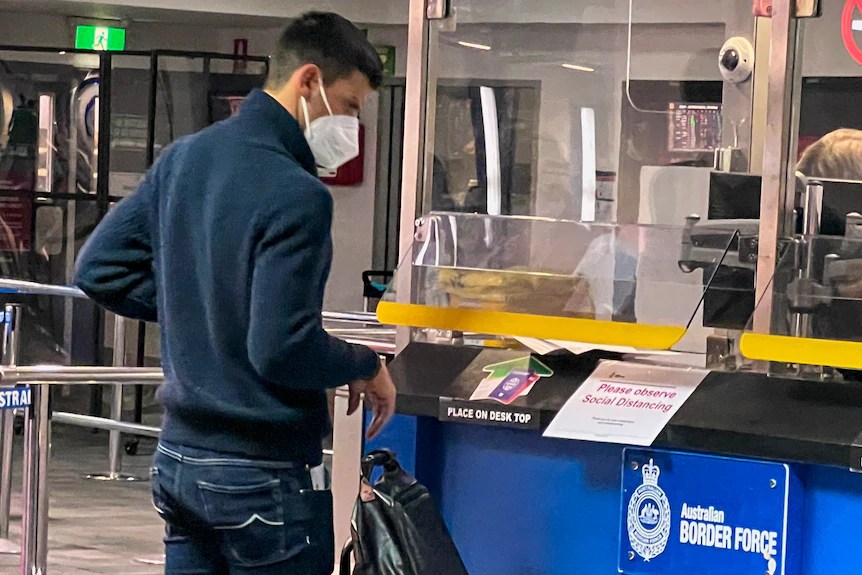
It will be obvious that Novak Djokovic never had a chance of playing in the Australian Open. Had the Federal Court ruled in his favour today, and had his visa been reinstated a second time, police would have tracked him around the clock and fined and arrested him for a minor infringement, say, chewing gum within a hundred yards of a church. His visa would have been cancelled a third time and his gum confiscated. Something or things would have been done to obstruct Djokovic’s participation in the Open. It was not for nothing that Djokovic’s lawyer requested when the Federal Court adjourned to deliberate and make a decision that, if the court ruled in Djokovic’s favour, an order be made requiring the tennis star’s immediate release within 30 minutes of the decision being handed down. Not in a couple of days’ time, in other words, after the start of the Open. A federal election looms. Keeping people out is a vote-winner.
It is tempting to say that the popular mood against Djokovic is just the result of pent-up frustration with anti-vaxers after numerous and lengthy lockdowns in Melbourne, the city where the Australian Open is held. Except it’s not just anti-vaxer hate. There’s a more than a generous dollop of good old xenophobia in the mix. Three other tennis players, who were also under the impression that they had an exemption and could participate in the Australian Open unvaccinated, read the mood better than Djokovic and left Australia quietly.
Xenophobia in Australia is based purely on location and time, not origin, race or religion, the more ordinary bases of xenophobia on display elsewhere in the world. Over 27 per cent of Australian residents were not born in Australia. Over 45 per cent of Australian residents have one parent born overseas. Origin, race and religion are distributed in too scattered a way to function as a focus for Australian xenophobia.
Consequently, the us-and-them of Australian xenophobia can’t be based on who ‘them’ are, but basing it on where ‘them’ are has proved to be a workable alternative.
Australian xenophobia works as follows. If you’re not here right now, you’re not one of us, and we are at best indifferent to you. If you’re here right now but for some reason we think you should not be here right now, you’re also not one of us, and we despise and hate you. A poll found that 71 per cent of Australians want Djokovic expelled from the country. Sure, Djokovic has never been liked here (or elsewhere apart from Serbia), but kicking him out of the country for being among four players having apparently misunderstood vaccination requirements and in the absence of him posing a health risk, that’s hatred.
The Australian strain of xenophobia was on stark display in a government ruling, only recently lifted, that Australian residents were not able to leave Australia without an “exemption” during the pandemic. They still aren’t and must have a valid reason, such as a family visit or a funeral. The policy is that you’re part of ‘us’, and you can’t leave to go where ‘they’ are. It is a policy normally associated with totalitarian states like the defunct German Democratic Republic and North Korea. Public reaction to this policy, which was prompted by the COVID pandemic but seemed to have no bearing on it, has been muted. People agree unless or until personally affected.
Neither did the Government lift a finger to repatriate Australian residents stranded overseas when it closed the federal border to non-Australian residents at the start of the pandemic, and commercial flights were reduced to a trickle, causing airfares to rise to levels only the rich could afford. Those Australian residents stuck overseas, and many were stuck for more than a year, were simply not welcome. They were not part of ‘us’. You would frequently hear the question what these Australians were doing overseas anyway. Australia not good enough?
Australian xenophobia did not stop at the federal border. In an effort to maintain zero-COVID in their itty-bitty bits of Australia, all states and territories banned their own citizens who were ‘intra-state’ from returning to their homes and livelihoods for shorter or longer periods. Western Australia is still closed at the time of writing. It was nauseating to hear the Premier of Queensland repeat her mantra: “We’re keeping Queenslanders safe”. Her effective definition of a Queenslander was someone legally a resident of Queensland located in Queensland right now. Any Queenslander outside Queensland was of no interest to her, and she did not seem to care if they lost their job, their house or their marriage as a result of her border policy.
This is not to say that Australia is a particularly xenophobic country. It’s probably just as xenophobic as any other country. Xenophobia, it seems, is a conditio sine qua non of community.
It could even be argued that the Australian community entertains a relatively benign form of xenophobia. Where all over the world people are excluded, persecuted, hated, maimed and killed because they were born somewhere else, are black, brown or not white enough, or believe in a god that doesn’t suit, Australia applies xenophobia only to people who are not here right now or who it feels should not be here right now. Try again tomorrow, says the Australian xenophobe, because as soon as you’re here and we think you should be, you’re one of us, regardless of nationality, race or religion.
How lovely!
